BepiColombo Closes In on Mercury After Eight-Year Journey
After nearly eight years in space, the joint European-Japanese mission BepiColombo has entered the final phase of its journey to Mercury. The two science spacecraft that make up the heart of the mission are now closing in on the Solar System’s innermost planet, preparing for orbit insertion later this year and the start of detailed scientific observations in 2027.
A Critical Milestone Reached
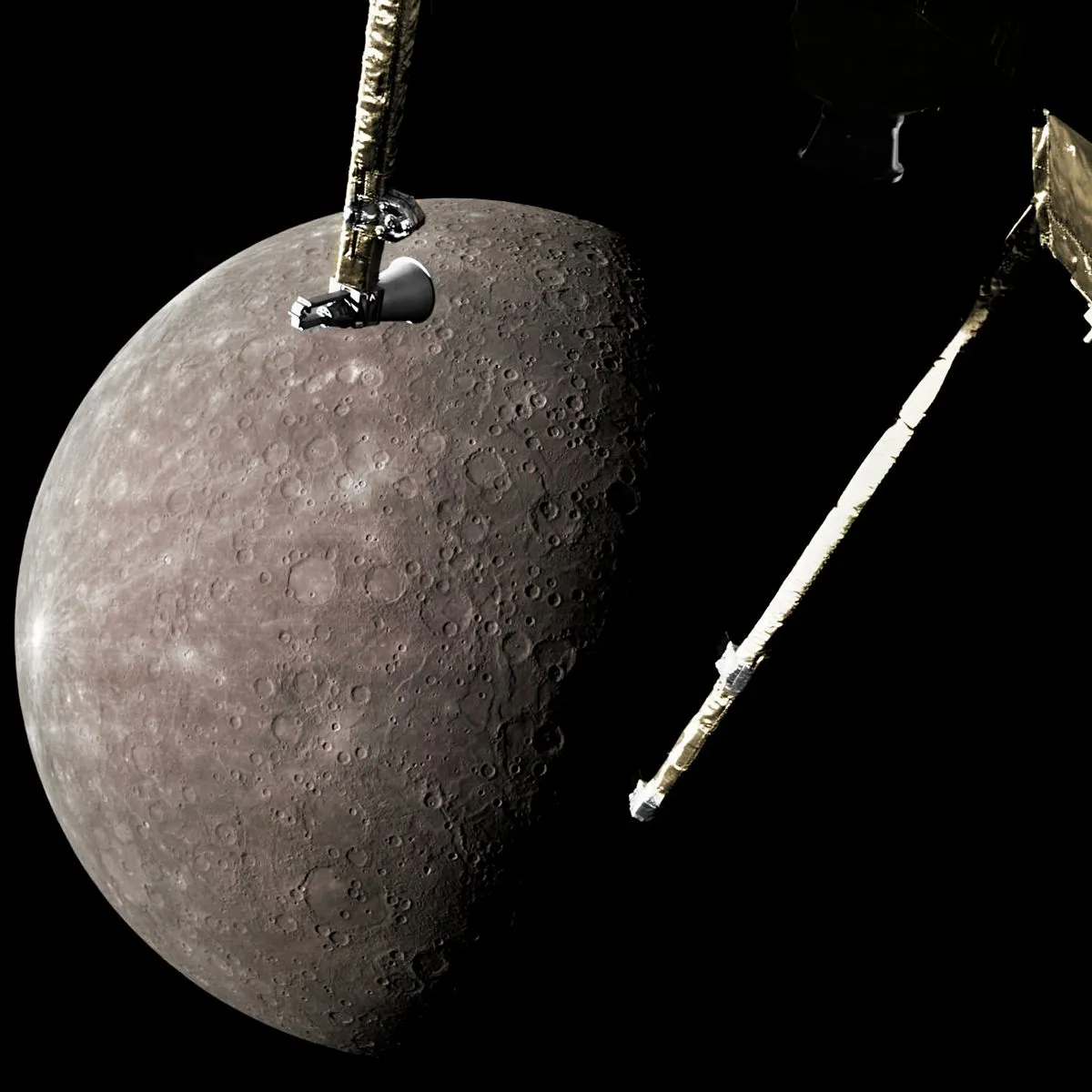
On 3 September 2026, BepiColombo successfully separated from its Mercury Transfer Module, the propulsion and power unit that carried it through the long cruise. The separation marked the formal beginning of the arrival phase. The two remaining spacecraft—Europe’s Mercury Planetary Orbiter and Japan’s Mercury Magnetospheric Orbiter, known as Mio—continue to travel together toward the planet.
Controllers confirmed the separation after signals travelled more than 120 million miles back to Earth. With the transfer module jettisoned, the stacked orbiters are now on a trajectory that will allow Mercury’s gravity to capture them.
Why Reaching Mercury Is So Difficult
Mercury is the closest planet to the Sun, yet it is one of the hardest to orbit. Spacecraft falling inward toward the Sun gain speed. Without careful intervention they would simply race past the planet. To be captured into orbit, a mission must shed a large amount of energy.
BepiColombo solved this problem through a combination of gravity assists and solar-electric propulsion. The spacecraft performed multiple flybys of Earth, Venus and Mercury itself, each carefully timed to slow its path. Ion thrusters provided continuous low thrust over years. Even so, a partial loss of thruster power in 2024 forced engineers to extend the cruise by about a year, shifting arrival from the original target into late 2026.
The mission has travelled more than 10 billion kilometres. The long duration and complex trajectory illustrate how demanding it is to place spacecraft in a stable orbit around a planet so deep in the Sun’s gravitational well.
The Coming Months
The next major event is scheduled for 21 November 2026, when the joined orbiters are expected to be captured into an initial wide orbit around Mercury. In December the two spacecraft will separate. Mio will move into a higher elliptical orbit optimised for studying the planet’s magnetic environment. The European orbiter will gradually lower itself into a closer polar orbit better suited to mapping the surface and probing the interior.
Routine science operations are planned to begin in April 2027, once both spacecraft have reached their operational orbits and instruments have been commissioned.
What the Two Spacecraft Will Study
BepiColombo is the first mission to place two complementary orbiters around Mercury at the same time. The division of labour is deliberate.
The Mercury Planetary Orbiter carries a suite of instruments to examine the planet’s surface composition, topography and geological history. It will measure the planet’s gravity field and test aspects of general relativity in the strong gravitational environment near the Sun. Cameras and spectrometers will map the surface in unprecedented detail, helping scientists understand why Mercury has such a large iron core relative to its size and how its surface has evolved under intense solar radiation and impact cratering.
Mio, the Japanese magnetospheric orbiter, focuses on the invisible environment around the planet. Mercury possesses a magnetic field, unusual for a small, rocky world. Mio will study how that field interacts with the solar wind, the structure of the magnetosphere, and the behaviour of plasma and charged particles. Simultaneous measurements from the two spacecraft will allow scientists to link surface processes with the surrounding space environment in ways a single orbiter could not achieve.
Together the mission aims to answer fundamental questions about how the innermost planet formed, why it looks so different from the other terrestrial worlds, and what its history reveals about the early Solar System.
A Long-Awaited Scientific Return
Only one previous mission, NASA’s Messenger, has orbited Mercury. Messenger transformed understanding of the planet but left many questions open. BepiColombo arrives with more advanced instruments, dual perspectives, and the ability to observe for at least a full Earth year, with the possibility of extension.
The data are expected to refine models of planetary formation, improve knowledge of how magnetic fields arise and decay in small bodies, and provide new tests of physics in extreme conditions. For planetary scientists, the wait of nearly a decade is about to yield a sustained stream of observations from the least-explored of the terrestrial planets.
Looking Ahead
The months between now and April 2027 remain operationally demanding. Trajectory corrections, the November orbit insertion, the December separation and the subsequent manoeuvres into final science orbits all require precise execution. Teams at the European Space Operations Centre and their Japanese counterparts have rehearsed the sequence extensively.
If the arrival proceeds as planned, BepiColombo will open a new chapter in the exploration of Mercury. After an eight-year voyage designed to overcome the unique challenges of the inner Solar System, two spacecraft will finally be in position to study the planet in depth—one focused on its solid body, the other on the magnetic and plasma environment that surrounds it. The real scientific journey is only now beginning.
Read more – atechsslaash.com , BestMenuHub.com