Web Development Trends 2026: AI-Powered Sites, React & Next.js
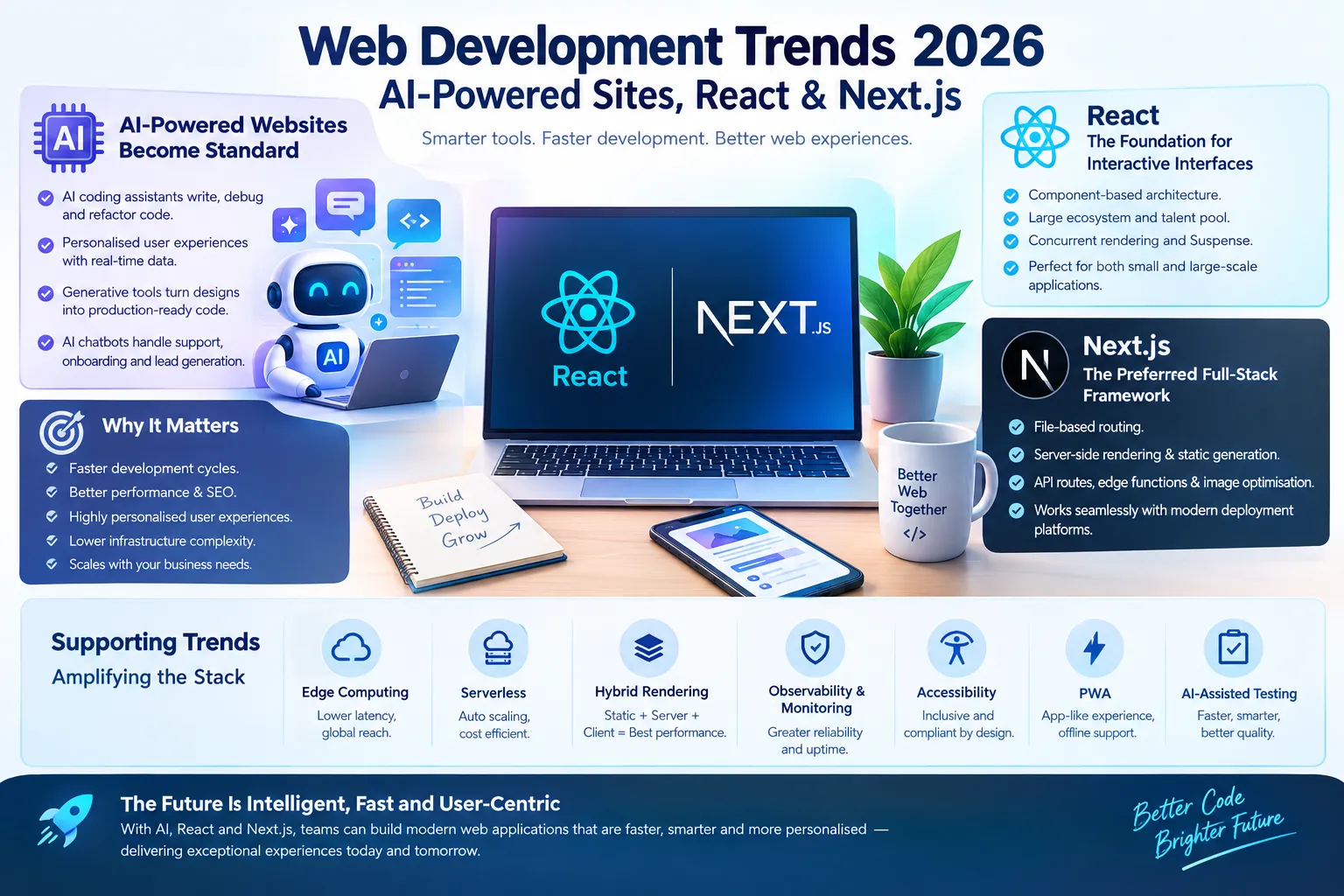
Web development in 2026 has entered a phase defined by intelligence, performance and developer productivity. Artificial intelligence is no longer an experimental add-on; it is embedded throughout the design, coding, testing and personalisation layers of modern websites. At the same time, React continues to dominate component-based user interface development, while Next.js has solidified its position as the leading full-stack framework for production applications. Together these forces are reshaping how teams build, deploy and maintain web experiences.
AI-Powered Websites Become Standard
Artificial intelligence now influences nearly every stage of the web development lifecycle. AI coding assistants generate boilerplate, suggest component structures, refactor legacy code and identify bugs in real time. Surveys indicate that a large majority of developers regularly use such tools, with many reporting significant weekly time savings on repetitive tasks.
Beyond development assistance, AI shapes the end-user experience itself. Websites increasingly adapt layouts, content and recommendations based on real-time behaviour, device context and predictive models. Intelligent chat interfaces handle support, onboarding and lead qualification, often integrating directly with customer systems. Personalisation has moved from simple rule-based logic to behaviour-driven prediction, enabling more relevant and responsive interfaces.
Generative capabilities also accelerate design-to-code workflows. Tools that convert design files into production-ready React components, generate accessible markup or optimise performance have become common. While human oversight remains essential for architecture, brand alignment and complex business logic, AI handles much of the routine work that previously consumed development hours.
React Remains the Foundation for Interactive Interfaces
React continues to lead as the most widely used library for building user interfaces. Its mature ecosystem, large talent pool and extensive component libraries make it the default choice for many enterprise and product teams. The component model, combined with strong community support and ongoing performance improvements, keeps React central to modern front-end development.
Recent iterations have focused on concurrent rendering, improved suspense mechanisms and better support for server components. These enhancements help applications remain responsive under heavy loads and improve the developer experience when managing complex state and data fetching. React’s flexibility allows teams to adopt it incrementally or as the core of large-scale applications, contributing to its sustained popularity.
AI tools integrate particularly well with React. Coding assistants trained on vast amounts of React code can generate functional components, hooks and patterns that align with common best practices, further accelerating delivery.
Next.js as the Preferred Full-Stack Framework
Next.js has emerged as the dominant meta-framework built on React. It provides a comprehensive set of capabilities—file-based routing, server-side rendering, static site generation, API routes, edge functions and optimised image handling—out of the box. This reduces the need to assemble and maintain multiple separate tools for common full-stack requirements.
Adoption data from software websites shows Next.js appearing on a substantial share of projects where a framework is detected, often far ahead of alternatives. Its appeal lies in the balance it strikes between developer experience and production performance. Teams can start with static generation for content-heavy pages, move to server rendering for dynamic data, and deploy edge functions for low-latency personalisation or authentication—all within a single coherent framework.
Next.js also aligns closely with modern deployment platforms that emphasise edge computing and serverless execution. This combination supports globally distributed applications that remain fast for users regardless of location while keeping infrastructure management lightweight.
Supporting Trends Amplifying the Stack
Several parallel developments reinforce the strength of AI-assisted React and Next.js workflows. Edge computing continues to reduce latency by running code closer to users. Serverless models allow applications to scale automatically and charge only for actual execution time. Hybrid rendering strategies—mixing static, server and client rendering—have become standard practice for optimising both performance and SEO.
Observability, accessibility and performance monitoring receive greater attention as sites grow more dynamic and personalised. AI-assisted testing and automated accessibility checks help teams maintain quality even as release velocity increases. Progressive web app capabilities remain relevant for delivering app-like experiences with offline support and reliable performance on mobile networks.
Practical Implications for Teams
Organisations building or modernising web applications in 2026 benefit from treating AI as a core productivity layer rather than an occasional experiment. Establishing clear guidelines for AI tool usage, code review standards and data handling protects quality and security while capturing efficiency gains.
Choosing React and Next.js provides access to a large talent market, extensive documentation and a proven path from prototype to high-traffic production systems. Teams can focus engineering effort on unique business logic and user experience rather than reinventing routing, data fetching or deployment pipelines.
Performance and user experience remain non-negotiable. AI personalisation and dynamic features must be implemented with careful attention to Core Web Vitals, accessibility and graceful degradation. The most successful sites combine intelligent adaptation with fast initial loads and reliable interaction.
Looking Forward
Web development in 2026 is characterised by higher leverage for developers and richer, more adaptive experiences for users. AI compresses the time required for routine work, React continues to provide a robust foundation for interactive interfaces, and Next.js supplies the full-stack structure needed for modern applications. Teams that integrate these capabilities thoughtfully—balancing automation with human judgment, performance with personalisation, and speed with maintainability—are well positioned to deliver digital products that meet rising expectations for both capability and quality.
Read more – starbiofact.com