How Tesla Roadster Jumps, Flips and Lands: Science Explained
Elon Musk’s new Tesla Roadster has taken the idea of a supercar into territory previously reserved for science fiction. During its public demonstration, the electric sports car lifted off the ground, rotated in mid-air and landed under control using thrusters developed with SpaceX. The spectacle looked like rocketry applied to a road vehicle, yet the underlying technology is more precise and more limited than continuous rocket flight.
Cold Gas Thrusters, Not Combustion Rockets
The system relies on cold-gas thrusters rather than chemical rockets. Instead of burning propellant, the Roadster stores highly compressed gas—primarily air or nitrogen—in composite overwrapped pressure vessels, the same type of tanks SpaceX uses on its rockets. When a valve opens, the pressurised gas is expelled at high speed through carefully oriented nozzles. The rapid ejection of mass in one direction produces an equal and opposite force on the vehicle, an application of Newton’s third law of motion.
Reports from the unveiling indicate that the high-performance “Rocket” configuration carries roughly 250–260 kilograms of compressed gas distributed across multiple tanks, with a total volume on the order of 600 litres. Approximately ten nozzles are positioned around the car—under the floor, at the rear and at strategic points for attitude control. Coordinated firing of these nozzles allows the vehicle to generate lift, control orientation and cushion landings for brief periods.
Generating Lift and Controlling Orientation
To leave the ground, downward-pointing thrusters expel gas toward the surface. The resulting upward reaction force can exceed the weight of the car for short bursts, enabling it to rise several metres. Once airborne, smaller or angled thrusters provide attitude control. By firing selectively, the system can induce rotation around different axes, allowing the car to roll, pitch or yaw in a controlled manner.
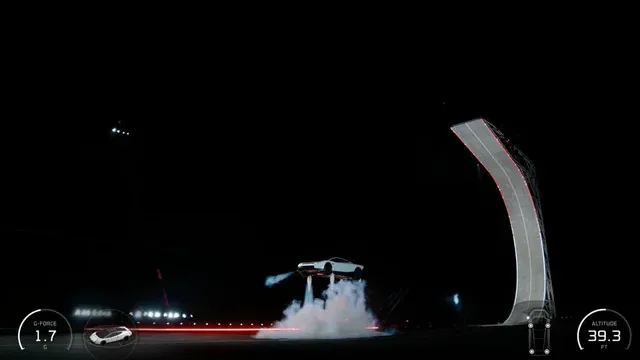
In the demonstration, the Roadster performed a mid-air roll after leaving a ramp and another manoeuvre described as a “kickflip” while clearing a line of parked vehicles. Telemetry and visual evidence showed thrusters at multiple corners firing in sequence to initiate rotation, stabilise the vehicle and then slow its descent. The same principle used by spacecraft for fine orientation adjustments in orbit is here applied in a denser atmosphere for a few seconds of controlled flight.
Landing Softly
A critical part of the demonstration was the controlled landing. As the car descended, downward thrusters fired again to reduce vertical velocity. This braking effect limited the impact forces when the wheels touched the ground. Without such thrust, a vehicle falling from several metres would experience a hard landing. With precisely timed pulses, the system can bring the car down relatively gently, as shown by the cloud of vapour and the intact landing on all four wheels.
The duration of these manoeuvres is limited by the finite supply of compressed gas. Once the tanks are depleted, the thrusters can no longer generate meaningful force until the gas is replenished. Tesla has indicated that the vehicle can recharge its own air supply, removing the need for exotic propellants and making the system more practical for repeated short uses.
Complementary Suction System
Separate from the thrusters is a fan-based suction system mounted under the car. This system can generate substantial downforce—up to around two times the force of gravity—by creating a low-pressure region beneath the vehicle. The demonstration used this capability to drive the Roadster up a curved ramp and hold it inverted. While the suction system keeps the car pressed against a surface, the cold-gas thrusters handle the transition into free flight and the subsequent reorientation and landing.
Performance Beyond Traction Limits
The same thruster technology also contributes to extreme acceleration. Rear-mounted nozzles can provide forward thrust that is independent of tyre grip. Conventional cars are limited by the friction between tyres and road; once the available traction is exceeded, additional power simply spins the wheels. By adding thrust that does not rely on the tyres, the Roadster can accelerate harder than traction alone would allow. Demonstrated times from standstill to 96 km/h in well under one second illustrate the potential of combining electric drive with supplemental gas thrust.
Practical Limits and Purpose
These capabilities are designed for short, controlled bursts rather than sustained flight. The mass of the pressure vessels, the limited gas supply and the energy required to compress the air all constrain how long and how high the car can operate off the ground. Tesla has described the system as enabling obstacle clearance, dramatic manoeuvres and enhanced performance rather than routine aerial travel. The company has also noted that the most extreme configuration is not optimised primarily for safety in ordinary road use.
Engineering Adaptation from Space to Road
SpaceX developed cold-gas thrusters for precise attitude control in the vacuum of space and during atmospheric re-entry. Adapting the technology for a passenger car required new hardware, control algorithms and packaging solutions so that the system could function reliably in dense air, withstand road vibrations and integrate with the vehicle’s existing electric powertrain and chassis. The result is a hybrid of automotive engineering and spacecraft propulsion principles, applied on a scale and for durations suited to a high-performance road vehicle.
What the Demonstration Shows
The Roadster’s mid-air jump, flip and landing rest on straightforward physics executed with advanced engineering. Compressed gas stored at high pressure is released through nozzles to produce directed force. By controlling the timing, direction and magnitude of that force, the vehicle can lift, rotate and decelerate itself for brief periods. The spectacle is real, the science is established, and the practical application remains specialised—short bursts of controlled flight that expand the performance envelope of an electric supercar far beyond conventional limits.
Read more – insurancesach.com